
Banbury Castle history: the Civil War and its end
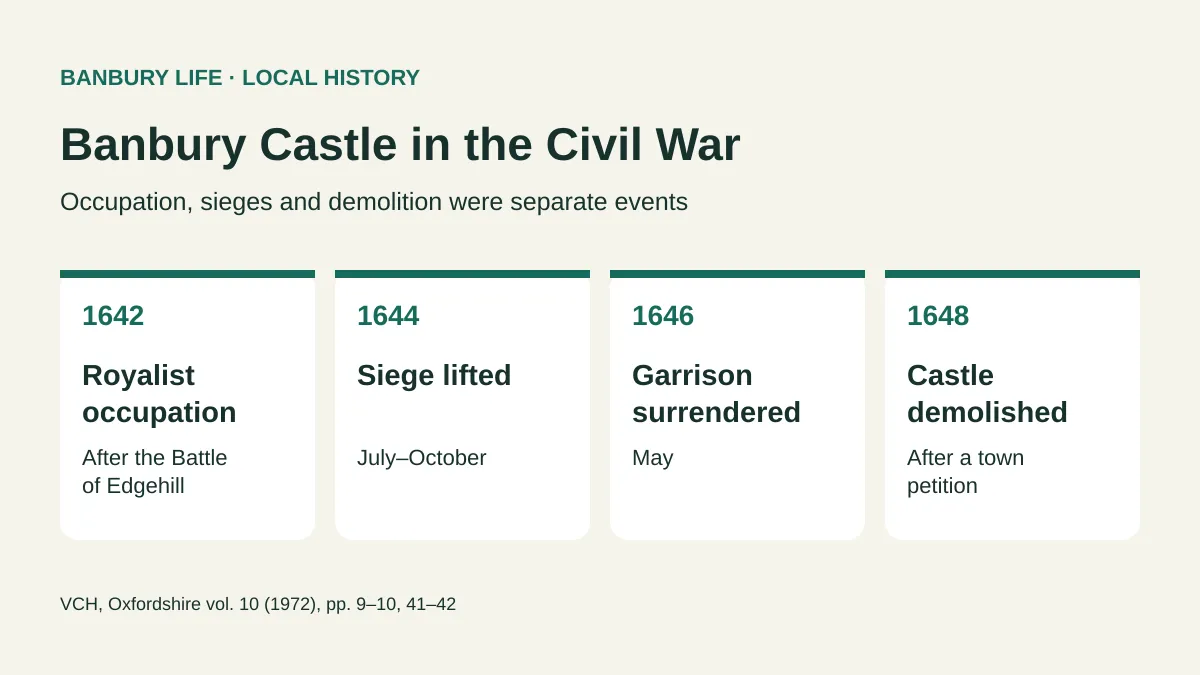
Banbury Castle stood north of Market Place, in the area later covered by Castle Street and the Wharf. Built for Alexander, Bishop of Lincoln, in the twelfth century, it became a Royalist stronghold during the Civil War, survived the 1644 siege and surrendered to Parliament in May 1646. Its demolition followed in 1648, after townspeople petitioned to use the materials to repair Banbury: surrender and destruction were separate events.
Where was Banbury Castle?
The Victoria County History’s castle account places the castle to the north of the later Market Place. The subsequent names Castle Street and Castle Wharf help locate the lost stronghold, but there is no standing medieval castle to tour there today.
The archaeological location is more precise than a place-name alone. Kirsty Rodwell’s report on the 1973–74 excavations, pp. 90–92, describes a site bounded by Market Place to the south and Castle Street to the north and north-east. Roads and buildings had already altered it, and shopping-centre redevelopment prompted the rescue excavation.
Stand in Market Place and look towards the Castle Quay side of town: that is the relationship to hold in mind. The marketplace lay beside a defended centre of power. Today’s shopping streets do not preserve a complete visible outline of its walls or moats.
A bishop’s castle before it was a battlefield
Alexander was Bishop of Lincoln from 1123 to 1148. The county history attributes the castle to him; choosing a single construction year is less secure than placing it in his episcopate. In 1139, King Stephen imprisoned Alexander and attempted to seize his castles. Alexander surrendered them but retained Banbury after his release. Source: VCH, castle section.
The bishops were landholders as well as churchmen. A castle could help administer estates, collect income, accommodate officials and confine prisoners. A 1552 description of Banbury’s castle lordship included houses, yards, courts, a garden, an orchard, a fish stew or pond, mills, fisheries and market income. That inventory shows a working estate rather than a fortress used only in war.
Excavation also changed the picture inherited from older histories. Peter Fasham’s final report on the 1972 excavations, pp. 71–75, records a sequence beginning in the eleventh century and a complete redesign and rebuilding of the castle in the thirteenth. Material initially interpreted as part of a motte—a castle mound—proved to belong to a rebuilding phase.
That correction is important. Archaeologists were testing a traditional interpretation, not simply looking for remains that would confirm it. The castle we imagine in 1644 had centuries of rebuilding behind it.
Why did Banbury Castle matter in the Civil War?
Banbury Castle was a Royalist outpost in an area with predominantly Parliamentarian sympathies. Its garrison could intercept troops, threaten other towns, obtain supplies and collect financial levies from the surrounding countryside. Banbury supplied provisions and money for the Royalist forces at Oxford, and the castle held both prisoners of war and civilians suspected of treachery. These functions are described in the county history’s Civil War narrative, pp. 9–10.
The contrast between town and garrison makes Banbury’s experience particularly sharp. The museum’s Civil War learning programme frames it as a Puritan town with a Royalist castle. That is a useful outline, though individual residents and soldiers did not all share one political outlook.
The castle had initially been held for Parliament. After the Battle of Edgehill on 23 October 1642, Charles I summoned it to surrender three days later. The county history says the garrison capitulated after apparently only one shot; about half the men then took service under the king. Banbury remained in Royalist hands for roughly three and a half years.
The 1644 siege failed to take the castle
Parliamentarian forces blockaded the roads around Banbury from 19 July 1644. A force of about 3,500 under Colonel John Fiennes entered the town on 25 August, facing a castle garrison of roughly 400 commanded by Sir William Compton. The VCH narrative distinguishes the blockade’s start from the later entry into town.
The besiegers built batteries and siegeworks. The county history places one battery probably in Market Place and another outside North Bar; it also reports guns on the church steeple. The garrison destroyed the steeple and houses near the castle. An attempt to storm the castle on 23 September failed.
Rodwell’s historical discussion, pp. 95–96, adds the mechanics of the struggle: a breached wall backed by earth, efforts to drain the moat, and plans to undermine the defences that were frustrated by springs. These are written siege accounts discussed in an archaeological report, rather than the discovery of a surviving underground escape route.
The siege ended in October when a Royalist relieving army approached. The county history dates its lifting to 25 October, as does Rodwell. Some summaries use 26 October; the secure broad chronology is July–October 1644. The castle had held out, but the surrounding town had absorbed much of the damage.
Repairs made the castle stronger—and damaged the town
Between the sieges, defenders enlarged and repaired the works. The castle account in VCH, p. 41, records a new moat after the 1644 siege, followed by two new bulwarks and two sally ports by early 1645. A bulwark strengthened a defensive position; a sally port allowed defenders to make sorties.
Buildings near the castle, including in Market Place, were pulled down to make room for works or clear the space between castle and town. A lengthy section of castle wall also collapsed during the extensions and needed repair. Stronger fortification came at a cost to the people living beside it.
Joshua Sprigge, writing after the 1646 siege, described the old castle as strengthened through work and ingenuity beyond many more famous places. His assessment, quoted by the county history, helps explain why a castle already old in the seventeenth century remained militarily troublesome.
The 1646 surrender was not the 1648 demolition
The siege was renewed early in 1646 under Parliamentarian command. The county history dates its renewal to January; Rodwell’s historical account describes a start at the beginning of February. The difference is a reason to avoid treating a single precise start date as universally agreed.
Compton rejected a summons to surrender on 18 March. The county history records capitulation on 8 May, after Parliamentarian mortars and heavy guns arrived. It suggests both the pressure of siegeworks and news that Charles I had gone to the Scottish army helped bring about surrender. The safest short timeline says May 1646; some modern chronologies use 9 May for the siege’s endpoint. Source: VCH, introduction.
In 1646, the initial decision was to destroy only the earth defences, taking account of the interests of Lord Saye and Sele. In 1648, Banbury’s inhabitants petitioned for the castle to be demolished and its materials used to repair the town. It was purchased for £2,000 and demolished. Two small buildings associated with the hundred court were left standing. Source: VCH, buildings, pp. 41–42.
That sequence explains why “destroyed in the siege” is misleading. The garrison surrendered; the later decision dismantled the castle. The inhabitants’ petition also puts rebuilding households and streets back into a story often told only through commanders.
What did the war do to ordinary Banbury?
The parish registers give a stark measure of disruption. The county history records an average of 73 burials a year in 1632–41, rising to 254 in 1643 and 299 in 1644. At least 161 plague victims were buried from March to November 1644. These are burial records, not a total of battle deaths: disease, troops in town and population movements affect the figures. Source: VCH, pp. 10–11.
Many civic officials fled during the worst disruption, and the town government was restored by Parliamentary order in 1646. Yet Banbury’s Thursday market was still operating in April 1645. Commerce did not simply stop while the castle fought. The market history feature follows that longer-lived part of town life.
Explore the castle story today
Use Market Place and the Castle Street area as above-ground reference points, rather than expecting exposed fortifications. For an object connected to the castle, Banbury Museum’s gallery guide lists a cannon from Banbury Castle in its collections. Displays can change, so ask staff if this is your main reason for visiting.
The museum’s visitor page gives free admission to the permanent Banbury and Waterways galleries, with the main entrance inside Castle Quay. Temporary exhibitions charge separately. For the full historical arguments, the two linked excavation reports are free to read online.
Historical sources checked on 19 November 2026. The cover is an original chronology diagram; it does not reconstruct the castle’s appearance.