
Banbury cattle market history: how big was it?
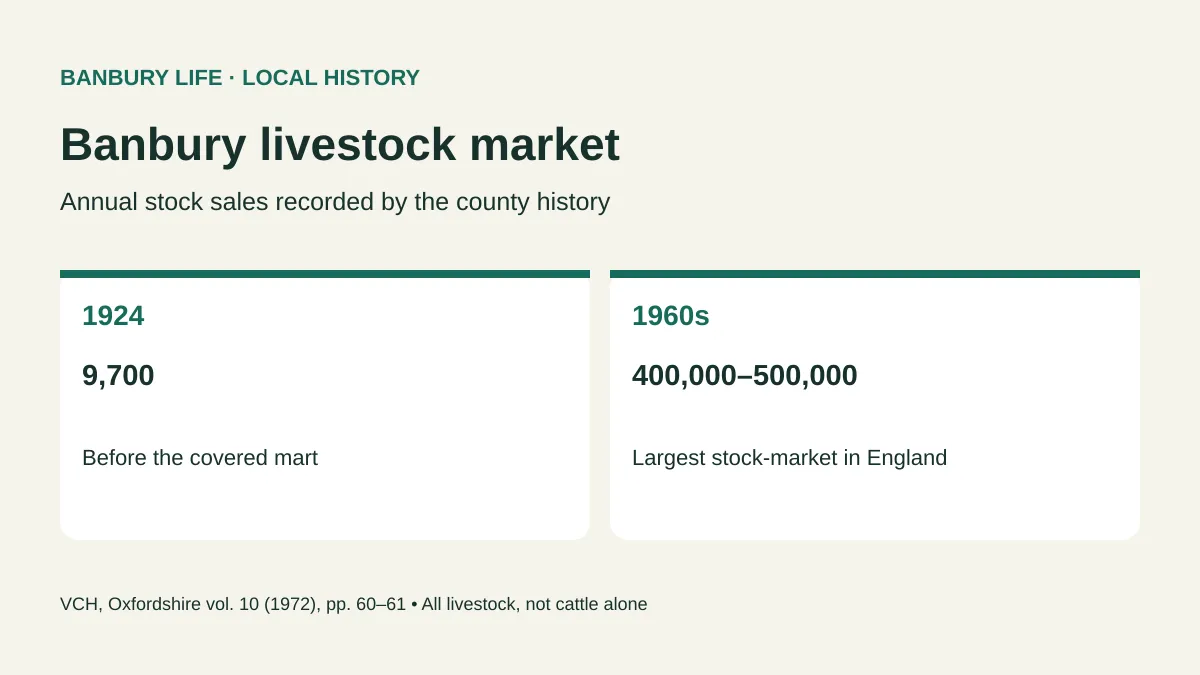
Banbury cattle market became the largest stock market in England by the 1960s, according to the Victoria County History, and Farmers Weekly described it as Britain’s biggest livestock sales centre in the mid-1980s. Those descriptions concern the twentieth-century Midland Marts business at Grimsbury, trading in several kinds of livestock. The familiar claim that it was “Europe’s largest” goes beyond the comparative evidence available here.
Banbury cattle market history begins before Grimsbury
Banbury’s market history and the history of its covered livestock mart are connected, but they have different starting points. In 1138–39, Alexander, Bishop of Lincoln, granted Godstow Abbey £5 a year from Banbury’s market tolls. A market was therefore already generating income before Henry II granted the bishop the right to hold a Thursday market in 1155. These dates come from the Victoria County History’s account of markets and fairs.
That is evidence of an established market, rather than a foundation date for a dedicated cattle auction. The county history’s account of the town’s origins allows that an earlier settlement may have had a market, but treats that as an inference. It does not establish a thousand-year continuous history for the later Grimsbury business.
For centuries, trading occupied different parts of the town. The names Ox Market and Sheep Market appear in records from 1319 and 1441 respectively. The county history places the cattle market probably at the east end of Market Place, and the sheep market at the east end of the modern High Street. “Probably” matters: these are reconstructions from documentary evidence, not boundaries measured on a surviving medieval market plan.
A market town worked through its streets
The old market was woven into ordinary town life. Pens, stalls, inns and the movement of animals shared the same limited space as residents and other businesses. In 1564, rules limited the charge for sheep pens to a penny for a hurdle’s length, with a higher rate on Corpus Christi Day. Visitors bringing sheep were required to use the pens.
The consequences could be fiercely contested. In 1656, the corporation ordered the sheep market moved because the pens left insufficient passageway. People in Sheep Street continued setting them up; two residents, armed with swords, challenged the mayor and aldermen over their rights. The dispute went to Oxford Assizes and then the Exchequer. The county history records both the practical problem and the dispute.
It is a useful way to understand a market beyond the animals sold. Charging for pens was income; moving the pens changed who received it. What looks like a simple rearrangement of a street could affect a household’s livelihood.
By the late nineteenth century, the fortnightly Thursday cattle market was substantial. The county history reports averages of 1,000 sheep and 1,200 cattle for fortnightly sales. Those figures describe that particular pattern of trading; they should not be presented as the later covered mart’s weekly totals.
Why Midland Marts moved the trade to Grimsbury
After 1918, increasing motor traffic made livestock sales in the streets more inconvenient. A covered market offered a different arrangement: animals and auction business could be concentrated on a purpose-built site.
The corporation first acquired land where the Warwick and Southam roads met. Its distance from the railway counted against it. A syndicate of stock traders instead bought a Grimsbury site and operated as Midland Marts Ltd. The corporation transferred cattle auction sales to the company in 1925, followed by private-treaty sales in 1931. After that second transfer, the corporation’s weekly Market Place market was for household retailers. Source: VCH, economic history, pp. 60–61.
A Banbury Guardian retrospective gives the formal opening as 2 April 1925. Accounts sometimes give different shorthand dates for the move; the documented 1925 transfer is the clearest anchor for the change in business.
Rail access and road connections helped make Banbury a collecting and distributing centre. The county history describes stock arriving from across southern England, with Scottish sheep and Irish cattle among occasional or seasonal consignments. Animals went principally to London and to Midlands and northern towns as far as Leeds. Banbury served a much wider area than its immediate farms.
Was Banbury cattle market the largest in Europe?
The best-supported answer is narrower: the Victoria County History calls Banbury the largest stock market in England by the 1960s, alongside annual sales figures of 400,000–500,000, compared with 9,700 in 1924. Farmers Weekly calls it Britain’s biggest livestock sales centre in the mid-1980s. Neither source establishes a Europe-wide ranking.
| Evidence | Market and period | What the statement supports |
|---|---|---|
| Victoria County History, published 1972 | Banbury’s Grimsbury stock market, 1960s | England’s largest stock market; sales of 400,000–500,000 livestock in the period’s annual figures |
| Farmers Weekly, 29 May 1998 | Midland Marts, mid-1980s | Britain’s biggest livestock sales centre; no Europe-wide comparison or ranking method given |
| Banbury Guardian, 2023 | Retrospective quoting a company information sheet issued nine years before closure | More than 600,000 head of stock of all classes annually, valued above £85 million; the article says “one of the largest in Europe” |
“Cattle market” is the familiar local name, but the larger totals concern stock of different classes, including sheep and pigs. Headcount, sale value, acreage and the number of cattle alone are different measures of size. A Europe-wide superlative would need a dated comparison using the same measure across competing markets. The quoted company figures and British rankings do not supply that comparison.
The market’s scale remains impressive without extending the claim. The distinction also avoids mixing a 1960s sales range with a later company total as if they came from the same year.
Why the market closed in June 1998
The final trading day was Thursday 4 June 1998. The contemporary Farmers Weekly closure report, published on 29 May, announced closure for the following Thursday; Banbury FM’s anniversary account records that final date.
The contemporary report describes several pressures together. Management cited high rent, rates, water and effluent costs; falling commission income; declining regional cattle numbers and livestock prices; and the repercussions of BSE. A proposed replacement at Huscote Farm near the M40 had become caught in a planning process after local approval was called in. The old site’s lease was expiring.
These were management’s explanations reported at the time, not a claim that any single factor caused the closure. Nor does the proposed new site mean the market successfully relocated. The report records Northamptonshire Auctions preparing to absorb some business, including changing its primestock sale days.
Explore the history without expecting a surviving mart
Today’s Market Place is a useful starting point for imagining the older street-based trade. Grimsbury tells the later chapter: Banbury FM identifies the former mart land as now occupied by housing, Dashwood Banbury Academy and Banbury Madni Masjid. These are present-day homes and institutions, not a livestock-market visitor attraction.
For a view of the working market, open the Oxfordshire History Centre’s 1960 photograph catalogue record, POX0561319. It identifies a new cattle shed and Midland Marts. The archive image is linked here rather than reproduced; its publication rights require permission.
Banbury Museum’s free local-history galleries provide broader context for the town’s commercial past. Continue with the castle and Civil War feature; the weekly market continued even during the wartime disruption of 1645. The Banbury history collection brings the market, castle and underground stories together with a timeline and an above-ground visit plan.
Historical sources and present-day references checked on 19 November 2026. The cover is an original Banbury Life comparison of sourced figures, not a historical photograph.