Banbury history: Cross, gates, inns, castle
Banbury history can be explored through its market, lost castle, medieval crosses, town gates, historic inns and excavated remains. This free Journal collection connects six source-linked chapters, with a short timeline and present-day landmarks to help you choose where to look. The chapters distinguish surviving buildings from lost sites, recorded dates from traditions, and today’s Cross from its medieval predecessors.
Six routes into Banbury history
| Read | The question it answers | What to look for |
|---|---|---|
| Banbury Cross history and the nursery rhyme | Which crosses were destroyed, why was today’s monument built, and who was the fine lady? | Medieval High, Bread and White crosses; 1859 monument; separate 2005 statue; changing recorded verses and competing rider theories |
| Banbury bars: South, West and North | What were the bars, where were they, and was Banbury walled? | Four town gates, toll collection, aliases, removal dates and the uncertain East/Cole Bar site |
| Banbury’s historic pubs: Swan and Reindeer | Which buildings are meant, how old are they, and what is known about the Globe Room? | Swan at 3 South Bar; Reindeer complex at 47–48 Parsons Street; Unicorn complex at 17–20 Market Place; construction versus recorded inn use |
| Banbury cattle market history: how big was it? | Was the cattle market really Europe’s largest, and why did it close? | Medieval street trading versus Midland Marts; dated British rankings and stock-sale figures |
| Banbury Castle history: the Civil War and its end | Where was the castle, why did it matter, and when was it destroyed? | Royalist occupation, two sieges, surrender and later demolition |
| Banbury secret tunnels: evidence and local legends | What is known beneath Banbury, and which connections are folklore? | Excavated cellars and wells, historical siege mining and the evidence needed to establish a passage |
Read one chapter on its own, or follow the connections between trading streets, entrances, accommodation and rebuilding. The new Cross, gates and inns chapters expand the collection without retelling the cattle-market, castle or tunnel investigations.
A market town with crosses, gates and courtyard inns
Banbury’s medieval growth was tied to the Bishops of Lincoln. The Victoria County History places the castle’s construction under Bishop Alexander, whose episcopate ran from 1123 to 1148, and discusses the creation of a larger town and marketplace in the twelfth century. Source: VCH, origins and growth.
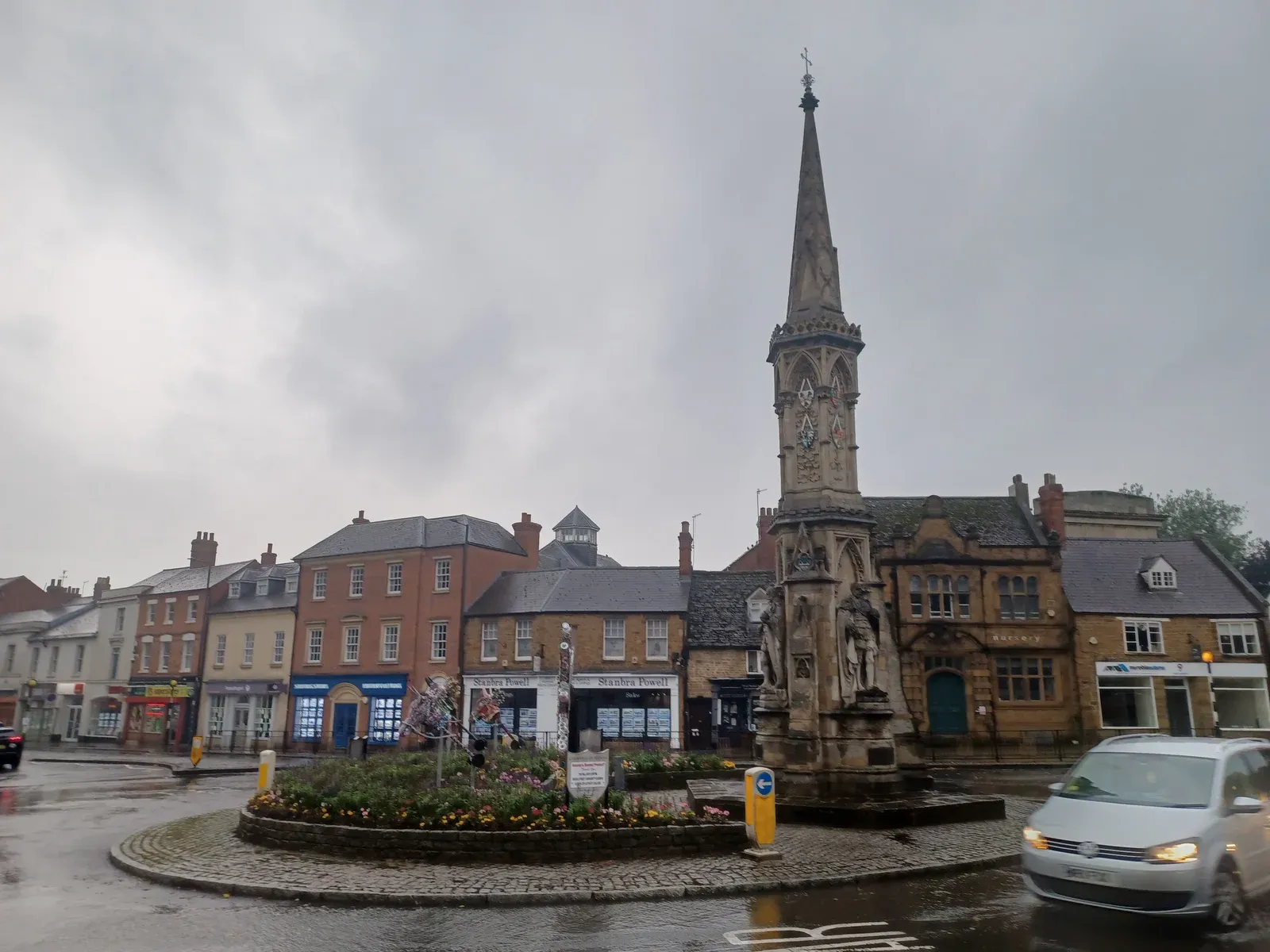
The older crosses belonged to different locations and functions. The High Cross stood in or beside Market Place, probably near the southern end of Cornhill; the Bread Cross stood where Butchers Row meets High Street. The White Cross marked a western boundary. Today’s Cross at Horse Fair is a Victorian commemorative monument, not a surviving medieval cross.
The bars were town gates, not drinking establishments. North, South and West Bar have relatively specific historical junction locations; East or Cole Bar is less certain. VCH suggests toll collection as their principal purpose, and does not establish a continuous defensive town wall. Read the gates chapter before using a street name as proof of a fortification.
Inns also need to be read by address. The Reindeer and Unicorn developed around courtyards that accommodated much more than a bar room. Surviving construction dates, written inn references and later alterations tell different parts of the story. The inns chapter explains why the Reindeer’s 1570 gates and the Unicorn’s 1648 gateway do not by themselves prove uninterrupted trading from those dates. Source: VCH, buildings.
A short Banbury history timeline
| Date or period | What happened | Source |
|---|---|---|
| Twelfth century, under Bishop Alexander | Banbury Castle was built beside the developing town | VCH: buildings |
| 1155 | Henry II granted the right to hold a Thursday market | VCH: economic history |
| 1268 | First recorded mentions of North and South Bar | VCH: origins |
| 1570 | Dated gates and a building phase at the Reindeer complex | VCH: buildings |
| 1600 | High Cross and Bread Cross demolished | VCH: origins |
| 1637 | Dated Globe Room addition at the Reindeer | VCH: buildings |
| 1642–48 | Royalist occupation, sieges, 1646 surrender and 1648 castle demolition | Castle chapter and its sources |
| Around 1744; 1784 | Recorded shopping verse, then a surviving old-woman version of the cock-horse rhyme | Rhyme chapter and its recorded-version sources |
| Around 1785–1817 | South, West and North Bar removed at different dates; Cole Bar had probably gone earlier | Gates chapter |
| 1859 | Present Cross erected to commemorate the Princess Royal’s marriage | Banbury Town Council |
| 1925 and 1931 | Auction sales, then private-treaty livestock sales, transferred to Midland Marts | VCH: economic history |
| 1972–74 | Castle-site rescue excavations before redevelopment | Fasham and Rodwell |
| 4 June 1998 | Midland Marts’ Banbury market closed | Contemporary closure announcement |
| 27 April 2005 | Separate Fine Lady statue unveiled | Banbury Town Council |
War and rebuilding changed the same streets
Banbury Castle became a Royalist stronghold in a town with strong Puritan and Parliamentarian sympathies. Damage, defensive works and disruption affected residents and buildings as well as soldiers. Yet the Thursday market continued in April 1645. Source: VCH, wartime introduction.
In 1648, inhabitants petitioned for demolition of the castle and reuse of its materials to repair the town. The castle chapter follows occupation, sieges, surrender and demolition in sequence. The Cross’s 1600 destruction belongs to an earlier episode; the Globe Room’s later Cromwell and Prince Rupert stories are treated as traditions in the inns chapter.
Archaeological reports add another view of rebuilding: cellars, wells, ditches, demolition layers and surviving deposits. They establish substantial underground history without requiring a connected tunnel network. The excavation behind the Reindeer also found a fifteenth-century masonry kitchen, which the inns chapter distinguishes from evidence of a medieval pub.
Explore Banbury’s history above ground
This is a selection of self-guided stops, not a timed tour or a measured walking route:
- Banbury Museum & Gallery: begin with the Banbury Gallery and its everyday-life and commercial history. The museum’s collections include a cannon from the castle; displays can change, so ask staff about a particular object. The official visitor page gives hours, holiday closures and access details. Permanent Banbury and Waterways galleries are free; temporary exhibitions charge separately.
- Market Place and Cornhill: connect the cattle-market chapter with the older trading streets and the High Cross’s probable location. The later Grimsbury livestock mart was a different site. Look at the historic Unicorn frontage without assuming its courtyard is open to visitors.
- High Street and Butchers Row: relate the Bread Cross to its documented former junction. There is no surviving medieval cross to enter here.
- The present Cross and Fine Lady: at High Street, Horse Fair, South Bar and West Bar Street, compare the 1859 monument with the separate 2005 sculpture. View the Cross from the surrounding pavements; do not enter the traffic roundabout.
- South Bar and Parsons Street: see the Swan’s façade at 3 South Bar and the Reindeer complex at 47–48 Parsons Street. The inns chapter links current Swan and Reine Deer contact information; ask the Reine Deer about Globe Room availability and access before making a special visit.
- Castle Street and Castle Quay: relate the lost castle to the published excavation location plans. There is no standing castle to enter.
Keep exploring to public areas and authorised visitor spaces. Private cellars, wells, cavities, courtyards and building sites are not part of this suggested visit.
Read further or contribute a source
The Victoria County History’s Banbury volume is the principal documentary synthesis used here. The focused chapters add council records, listed-building descriptions, museum commentary, local scholarship, contemporary market reporting and excavation evidence beside the claims they support.
Banbury Historical Society’s 1964 Reindeer and Globe Room studies are particularly useful for distinguishing the room’s architecture, later removal and recovery, and the traditions attached to it. Oxfordshire History Centre’s 1960 cattle-shed photograph record offers another view of Midland Marts; an archive catalogue description is not permission to reproduce its image.
Have a correction, dated photograph or firsthand memory? Contact banbury-life@brainer.one, including the source and any reproduction permission. We welcome memories with their context and keep them distinct from documentary or excavated evidence.
Cross, gates and inns additions reviewed on 23 November 2026; earlier market, castle, underground and museum visitor research reviewed on 19 November 2026. Cover photo: Banbury – Banbury Cross by Simon Burchell, 22 September 2024, via Wikimedia Commons. Resized and converted to WebP, with the original framing retained; this cover image is available under CC BY-SA 4.0.